Do I Have OCD?
If you’ve been Googling this question, something has probably felt off for a while.
OCD is one of the most misunderstood and misdiagnosed conditions out there — and one of the most misrepresented in the media. People are often told they just have anxiety, or that they’re overthinking, or that they need to relax. It’s maddening. And it means a lot of people are suffering longer than they need to.
OCD isn’t just about hand washing or liking things neat. It shows up in a lot of ways most people don’t recognize.
Common OCD subtypes
Harm OCD
Intrusive thoughts about hurting yourself or someone you love, even though the idea horrifies you. You might avoid knives, driving, or being alone with people you care about.
Pure O
Obsessions that seem to exist only in your mind, with no visible compulsions. The compulsions are there though — they’re mental. Reviewing, reassuring yourself, trying to “figure out” if the thought means something.
Relationship OCD
Relentless doubt about your partner, your feelings, or whether your relationship is “right.” Not ordinary relationship stress — a loop that never fully resolves no matter how much you analyze it.
Contamination OCD
Fear of germs, illness, or making others sick. Can extend beyond physical contamination to feeling morally or emotionally “contaminated.”
Scrupulosity
Obsessive fear of being a bad person, sinning, or acting against your values. Often looks like excessive guilt, confession, or moral rumination.
Symmetry & Order
A need for things to feel “just right” that goes beyond preference into genuine distress when it isn’t.
What OCD actually looks like day to day
The cycle is predictable — but from the inside, it feels impossible to break. Here’s what it looks like.
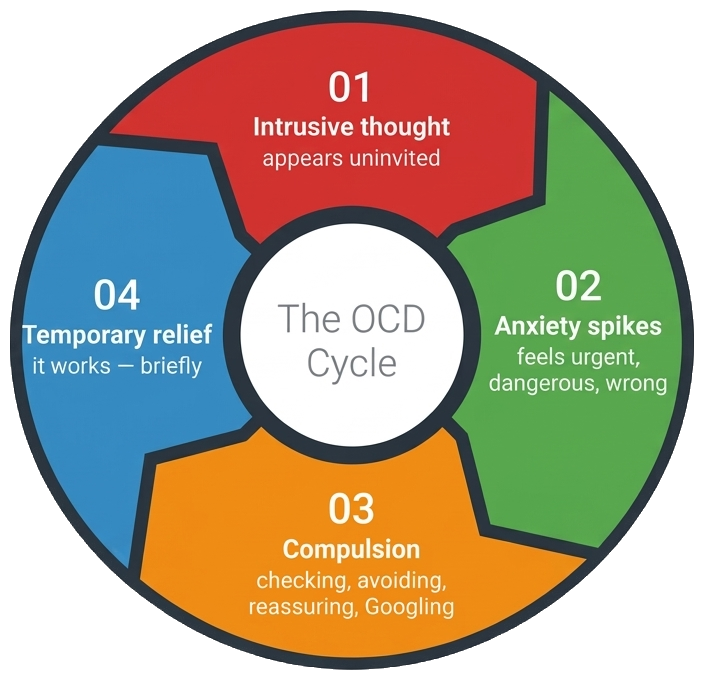
The compulsion feels like it’s helping. It’s actually keeping the cycle going. Every time you do it, you’re teaching your brain that the thought was worth responding to — and that the only way to feel okay is to do the compulsion again.
ERP works by interrupting that pattern. It’s not about eliminating intrusive thoughts — it’s about changing your relationship to them.
A note on diagnosis
You don’t need to have every symptom, and you don’t need to be sure. If any of this is ringing a bell, that’s worth paying attention to. A proper assessment with someone trained specifically in OCD can give you real answers — and a path forward that actually fits what you’re dealing with.
Schedule a free 15-minute consultation →